Company histories
Company histories that are about people
I have written company histories for family businesses, listed companies and engineering workshops. Every book is built from the company’s own stories, interviews and archives. On this page you will find the books I have written and how a book comes together.
Company histories written
7 books
-
 2026 50 Years of Junttan People and innovation at a piling rig manufacturer from Kuopio
 -
 2025 Makron 50 years Half a century of Makron, Lahti
 -
 2024 Aava 60 Sixty years of family enterprise and Finnish healthcare
 -
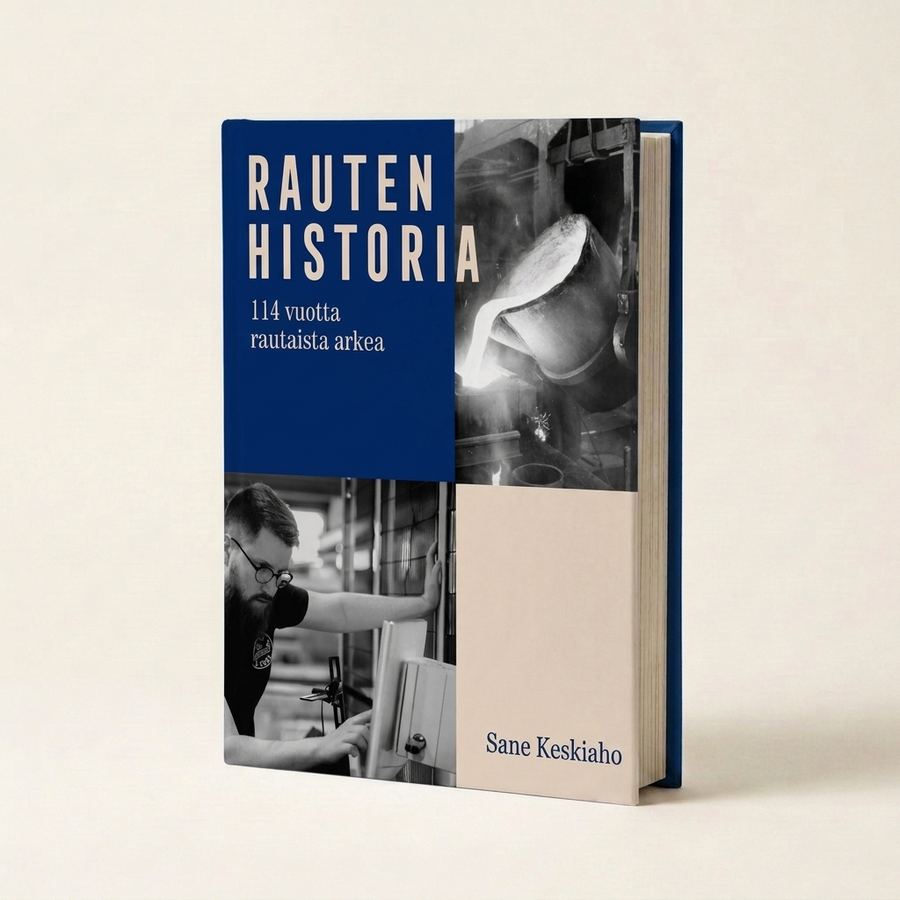 2022 Raute 114 years A listed company’s history from its founding to today
 -
 2019 Kemppi 70 years Three generations on the way to the top of welding
 -
 2017 A Decade of Change Luhta’s short history of a decade of change
 -
 In progress Orfer 50 years Iron and robostics
Company history
A company history is the company’s memory
A company history is more than a list of years, revenues and headcounts. It tells how it all began, which people built the company and which decisions changed its course.
A good company history is still worth reading decades later. That is why the telling should stay close to storytelling and leave room for people’s own memories, including the ones that do not fit the official version.
The book serves several purposes. It is an anniversary gift for employees, customers and partners, onboarding material for new hires, and a way to capture knowledge that otherwise disappears as people retire.
How we work
How a company history is made
Every company history is a different project, so the process is always planned around your company, your material and your goals, and you stay involved throughout.
-
Planning
We start with a meeting that covers the goals, the audience, the scope, the schedule and the budget. We also agree who owns the project inside your company and who is worth interviewing.
-
Research
I go through the archives, old brochures, staff magazines, photographs and earlier books. Interviews are the heart of the work: I talk to current and retired employees, owners, customers and partners.
-
Manuscript
The manuscript is developed throughout the project and reviewed with you at agreed points. Facts are checked, and every interviewee sees their own quotes before the book goes to print.
-
Design and finished book
The book is laid out either by our graphic designer or by yours. Images are processed, the layout is approved and the book is finalised for print. If you like, we also produce a PDF or a flipbook version.
In most cases a company history takes at least 12 months from the kick-off meeting to the printed book. That is why planning should start well before the anniversary.
FAQ
Frequently asked questions
How long does a company history take?
Reserve at least 12 months from the kick-off meeting to the printed book. Larger projects with dozens of interviewees take longer. If the anniversary date is known, get in touch well in advance.
What does a company history cost?
The price depends on the length of the book, the number of interviews, the design, the image work and the print run. I always quote per project, once we know what we are making.
How much work does the project take from us?
You need one person who helps with the material and the interview arrangements and comments on the manuscript at agreed stages. The rest of the work is mine.
What material do you need from us?
Everything you have: archives, minutes, photographs, old brochures and staff magazines, earlier books and press clippings. The best material is often in people’s memories, so a list of possible interviewees matters too.
Who does the interviews?
I do. The interview is the most important stage of the work, and it produces the material that no archive holds.
Who designs the book?
The layout is done either by our trusted graphic designer or by yours, if you want to keep the book in your own visual identity. My network also includes layout artists, photographers and illustrators.
Can the book be made in several languages?
Yes. Makron’s 50th anniversary history, for example, was published in both Finnish and English. Remember to allow for the translation and two layouts in the schedule and the budget.
Who keeps the material afterwards?
The finished book and its material are yours. The interview recordings and transcripts can be archived for the company, so the stories survive beyond the book as well.